The AI writes the lesson.
You decide what is made.
Tavira AI is the language model that reads your document and drafts the teaching. It writes words and choices; it never draws the film, approves it or publishes it. The examples below are taken from the lockout/tagout course on the course records page.
Who does what
| Part | Its job | What it cannot do |
|---|---|---|
| Tavira AI | Reads the document and drafts objectives, narration, knowledge checks, figures and a scene direction for each line, quoting the passage behind every line. | Run code, approve a film, publish a course or see other accounts. |
| Tavira checks | Rejects quotes that are not in the source word for word, headings used as evidence, narration that says more than the passages it cites, figures that do not appear in their quote, unknown scene types and narration that will not fit the chosen voice. | Judge whether the teaching is good. That is your review. |
| Customer | Reads every scene beside its source, edits the narration and look, approves the film and decides when to publish. | Add a figure that is not in the source. |
| Cloud worker | Records the narration, times the captions to the voice, draws each frame from fixed, tested scene templates and checks the finished film. | Change the words you approved or invent visuals outside the templates. |
What Tavira AI wrote for one chapter
This is the saved draft for chapter 4 of the lockout/tagout course. Tavira AI wrote all of it except the scene 8 narration, which the customer edited in the storyboard.
{
  "title": "Devices",
  "objective": "Compare lockout and tagout use and device traits.",
  "takeaway": "Use lockout when possible; tags need equal protection.",
  "scenes": [
    {
      "scene": 7,
      "template": "Process path",
      "headline": "Lockout is preferred",
      "narration": "If an energy-isolating device can be locked out, employers must use lockout unless a tagout procedure provides equal protection.",
      "source": {
        "section": 17,
        "quote": "employers must use lockout devices unless they develop, document, and use a tagout procedure"
      }
    },
    {
      "scene": 8,
      "template": "Stat focus",
      "headline": "Tag attachment strength",
      "narration": "Devices must be durable, standardized and substantial. Tag attachments need a minimum unlocking strength of at least 50 pounds.",
      "figure": {
        "label": "Minimum tag unlocking strength",
        "value": 50,
        "unit": "pounds",
        "kind": "requirement"
      },
      "source": {
        "section": 19,
        "quote": "of 50 pounds."
      }
    }
  ],
  "knowledgeCheck": {
    "question": "When must lockout be used?",
    "options": [
      "When equal tagout protection is absent and lockout is possible",
      "Never",
      "Only for electricity"
    ],
    "answer": "When equal tagout protection is absent and lockout is possible",
    "explanation": "Lockout is required unless tagout gives equal protection.",
    "source": {
      "section": 17
    }
  }
}
From a figure in the source to the screen
- CustomerThe source says it
Section 19 of the OSHA booklet sets the minimum unlocking strength for tag attachments.
“Tag attachments must be non-reusable, self-locking, and non-releasable, with a minimum unlocking strength of 50 pounds.”OSHA 3120, PDF pages 18–19. The sentence crosses a page break.
- Tavira AITavira AI records a figure
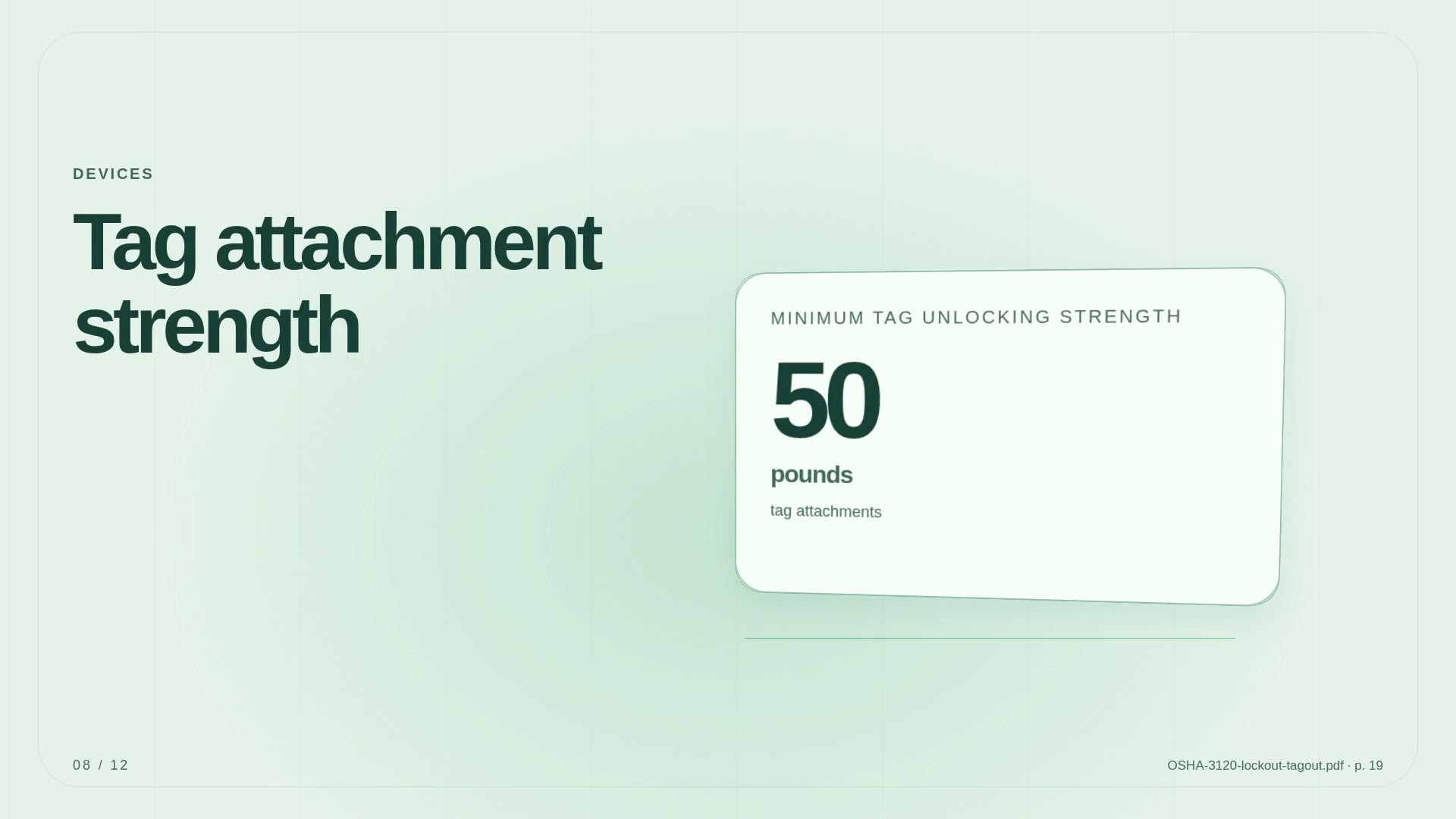
Minimum tag unlocking strength: 50 pounds, marked as a requirement, with that quote attached.
- Tavira checksTavira checks the quote and the number
The value 50 must appear in the quoted passage, and the quote must appear in section 19, or the draft is rejected. Tavira also checks every line of narration against the whole passages it cites, taken together: the words of the line must be in them, and a heading alone is never accepted as evidence.
- Tavira checksTavira checks how the number relates to the sentence
A number is only accepted when its relationships to the sentence it came from also match. For this figure the checks read:
- Subject
- tag attachments
- Unit
- pounds
- Condition
- minimum
- Status
- requirement
These checks reject three kinds of mistake:
- A correct number attached to the wrong object.
- A minimum described as a maximum.
- A forecast presented as an achieved result.
The checks cannot judge whether the teaching is good. Your review does.
- Cloud workerThe film shows it
Scene 8 uses the Stat focus template, which draws the bound figure as it is: 50 pounds.
- CustomerThe narration says it
The customer added the figure to the narration. Typing 40 instead was refused, because 40 is not in the scene's source passage.
Figures keep their meaning
Every figure Tavira AI uses is labelled with what it is, and the label stays with it into the storyboard. Tavira never calculates new figures; it copies values exactly from the source.
- Reported
- A stated actual or measured value, such as last year's result.
- Forecast
- A projection or outlook. The narration attributes it to its source.
- Target
- A goal, plan or proposed figure, not something that has happened.
- Assumption
- A scenario or assumed input used in the source's own analysis.
- Requirement
- A rule, limit or step value in a procedure or policy, like the 50-pound minimum above.
What two minutes cover
Each course is a two-minute overview. Tavira AI chooses six teaching objectives from the document's main sections and writes a short note on what the film covers and what it leaves to the full document. The lockout/tagout film, for example, says it covers the booklet's core ideas and does not teach its assistance programs and office listings. A two-minute film introduces a document; it does not replace reading it.
What the checks caught on real documents
- In a saved storyboard for the NIST small business security guide, one scene talked about roles, systems, contacts, authorities and notification laws but cited only the heading “Roles and Responsibilities”. That is too little to check it against. Tavira now refuses a heading as evidence and sends a line back to Tavira AI until the passages it cites say what the line says; every scene shows all of its passages in full, and you can add more from the source.
- On the clean run, Tavira’s checks sent the plan back to Tavira AI twice inside one attempt: seven chapters became six, and a quote that did not match the guide word for word was corrected.
- A wrong figure typed into the narration (40 pounds instead of 50) was refused before saving.
- Quotes that no longer matched because a Markdown file kept its link code: Tavira now imports Markdown as readable text.
- Narration too long for a slower voice: the word budget now follows each voice's measured pace, and the storyboard flags it before any film is made.
- Chart scenes chosen for a document with no suitable figures: they are shown as step scenes instead, and the change is noted on the storyboard.
- Two scenes where the speech recognizer heard other words than the script were flagged for the customer to listen to before publishing.